

Briefly
Bitcoin developer Cory Fields proposed hidden “landmines” that might let pockets house owners seize a quantum thief’s collateral.
Two public sale designs would goal apparently deserted cash, the place no person could also be round to spring a landmine.
Every thing stays hypothetical: Bitcoin would wish quantum-safe wallets, new consensus guidelines, and settlement on activate them.
Bitcoin developer Cory Fields has an uncommon thought for coping with future quantum thieves: Make them danger their very own Bitcoin each time they attempt to steal another person’s.
In a November 4 publish to the Bitcoin improvement mailing listing, Fields outlined “quantum landmines” and two sorts of auctions designed to show assaults on susceptible wallets into costly gambles. He known as the concepts “thought experiments,” not a accomplished Bitcoin improve.
Bitcoin house owners use a secret personal key to authorize transactions. An identical public key lets the community test their signatures with out studying the key.
If the entire thought appears too arduous to grasp, we used AI to generate a video that will help you grasp it:
As we speak’s computer systems can not realistically calculate that personal key from the general public one. A sufficiently highly effective quantum laptop may use a mathematical method known as Shor’s algorithm to do it, probably letting a thief spend cash as in the event that they owned them.
Some older Bitcoin outputs have uncovered public keys, and sure newer codecs reveal them too. Different addresses disguise the important thing till somebody spends, so the danger just isn’t similar for each pockets.
Researchers name the hypothetical arrival of a pc able to these assaults “Q-Day.” No publicly demonstrated machine can steal Bitcoin this fashion at this time, and no person is aware of precisely when one would possibly exist.
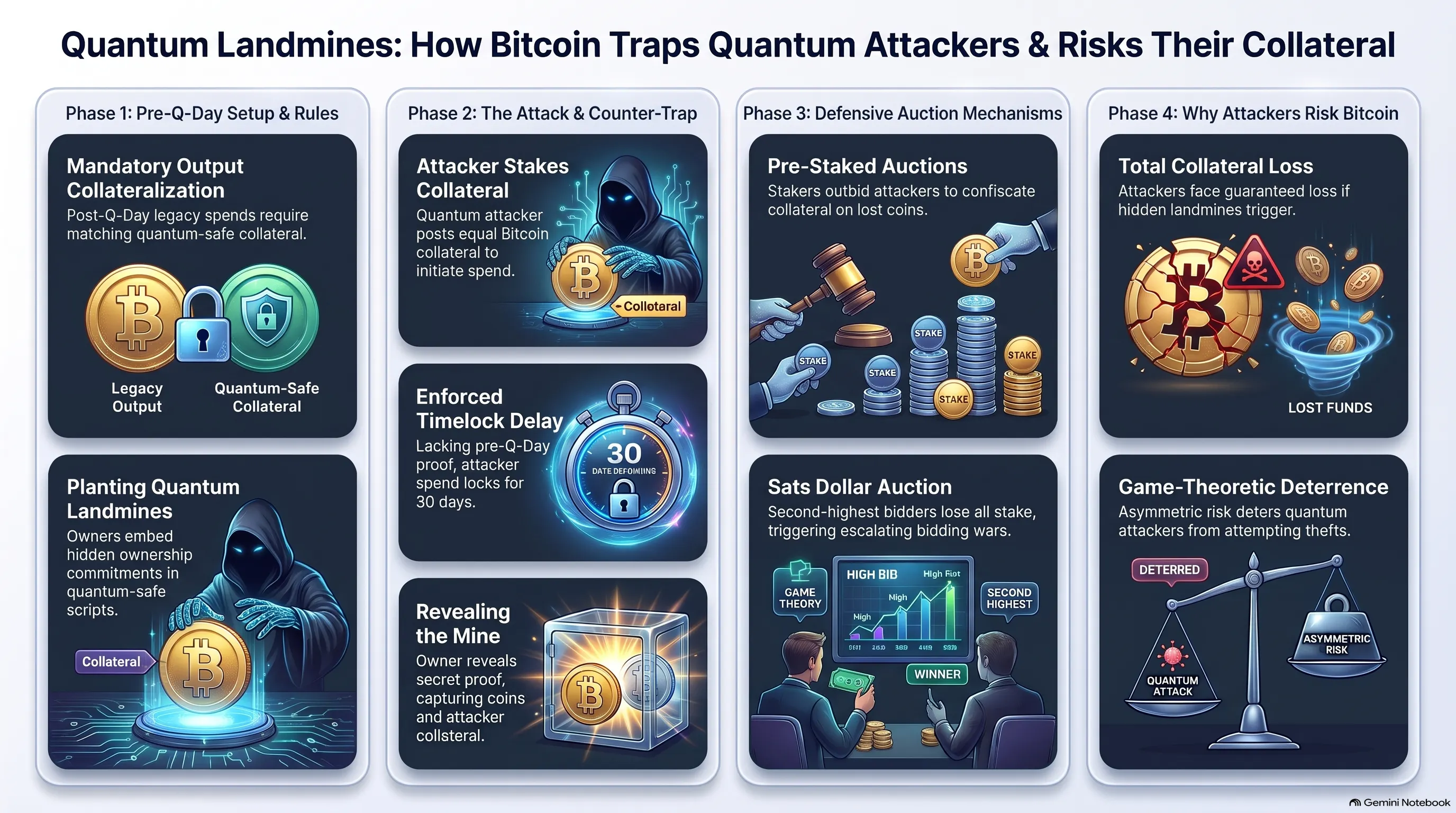
How does a quantum landmine work?
Think about somebody owns 1 BTC in an previous, probably susceptible pockets. Earlier than Q-Day, this individual creates a tiny, separate quantum-safe Bitcoin output containing a hidden proof that they managed the unique personal key whereas quantum theft was nonetheless not possible.
Consider it as a sealed possession receipt. Outsiders can see the small output, however not the proof tucked inside it, and even that it’s a lure.
Now think about a future thief makes use of a quantum laptop to recuperate the consumer’s previous personal key. Underneath Fields’s recommended guidelines, the thief can not merely take her 1 BTC: They have to add 1 BTC of their very own from a quantum-safe pockets as collateral.
Each cash enter a restricted output value 2 BTC. The thief should wait by means of a problem interval—30 days in Fields’s instance—earlier than spending it freely.
The pockets proprietor notices the transaction and divulges the pre-Q-Day proof. The community then permits the proprietor to maneuver the total 2 BTC to the quantum-safe handle they dedicated to earlier: their unique coin, plus the thief’s collateral.
The attacker has no strategy to know upfront which previous wallets comprise these hidden receipts. Even a profitable quantum key restoration may grow to be a 1 BTC loss.
The pockets proprietor would additionally want matching collateral to provoke a standard post-Q-Day transfer of her personal legacy coin. In the event that they don’t have any spare BTC, the identical rule meant to harm thieves may make shifting her financial savings troublesome.
What about misplaced or deserted cash?
Landmines solely work when an proprietor prepares one earlier than Q-Day and divulges it in time. They can not defend cash whose keys are already misplaced, together with a few of the early Bitcoin holdings extensively believed to be inaccessible.
Fields proposes a second mechanism known as a staked public sale. Earlier than Q-Day, somebody may lock up quantum-safe Bitcoin and secretly register a bid in opposition to a selected previous pockets they anticipate thieves to focus on.
Suppose an apparently deserted pockets holds 50 BTC. A future attacker tries to maneuver it and posts one other 50 BTC as collateral; through the public sale interval, somebody who dedicated a bid upfront can problem the tried theft.
In Fields’s instance, a profitable challenger claims a part of the attacker’s collateral whereas the unique susceptible cash are destroyed moderately than awarded to the bidder. The purpose is to deprive thieves of a dependable payday, not return the cash to a lacking proprietor.

BitcoinBTC · USD
$74,995−4.36%
24H7D1M1YYTD
Nov 2Nov 3Nov 5Nov 7Nov 9
$80.7k$78.5k$76.3k$74.1k
24h ExcessiveExcessive$76,106
24h LowLow$73,963
VolVol$835.7M
 →
$50$100$500
Purchase
His third thought, a sats public sale, requires no advance stake. As an alternative, a vulnerable-coin spend would set off a contest by which the best bidder will get the cash minus their bid, whereas the runner-up pays their bid and will get nothing.
That resembles a infamous public sale sport the place two bidders preserve elevating their gives as a result of neither needs to be the one who loses cash for nothing. A thief would possibly keep away from beginning a contest that might value greater than the cash they hoped to steal.
Why not simply freeze susceptible Bitcoin?
One proposed response to quantum danger is to limit spending from outdated wallets after a migration deadline. Which may stop theft, however may additionally completely lock out reliable house owners who by no means moved their cash.
Fields is exploring a unique trade-off: Maintain previous cash probably spendable, however make tried transfers pricey and open to challenges. Bitcoin can not inform an trustworthy proprietor from a quantum thief if each can produce the identical legitimate signature.
The trade-off is extreme, contemplating that trustworthy house owners would possibly want giant collateral deposits, inactive holders may miss their probability to object, and public sale guidelines would possibly burn cash belonging to people who find themselves nonetheless alive and easily offline.
What wouldn’t it take to implement?
Bitcoin would first want a quantum-safe strategy to maintain and spend funds. Wallets would then have to assist hidden possession commitments, whereas Bitcoin’s consensus guidelines must implement collateral, ready intervals, particular restoration transactions, and auctions.
Builders would additionally have to agree on when the brand new guidelines activate, how a lot collateral is required, and what occurs to shedding bids or leftover funds. Fields believes some mechanics may very well be launched by means of a delicate fork, a sort of Bitcoin rule change, however has not equipped the detailed design.
None of those protections exists in Bitcoin at this time. Fields has revealed no implementation or activation schedule, and his unique publish leaves the public sale payouts and even the specified final result of an public sale unresolved.
Day by day Debrief Publication
Begin daily with the highest information tales proper now, plus unique options, a podcast, movies and extra.
Be a part of 72,000+ readers


