Greater than $200 billion in crypto has flowed by way of Africa, but the infrastructure supporting that exercise is surprisingly troublesome to see. Not like North America, Europe, and elements of Asia, the place crypto exchanges, fee networks, custodians, and blockchain firms have turn into extra seen elements of the monetary system, Africa’s crypto exercise usually runs by way of a much less apparent mixture of exchanges, casual markets, and cross-border companies.
So the place does all of the African crypto exercise really occur? And what infrastructure strikes, shops, converts, and settles these property throughout the continent? The query isn’t whether or not Africans use crypto. The exercise is already there. The larger query is why the methods supporting lots of of billions of {dollars} in crypto flows stay so fragmented and troublesome to see.
What Does the $200 Billion+ Determine Truly Symbolize?
The $205 billion determine doesn’t symbolize cash invested in African crypto markets. It’s the estimated worth of crypto acquired by addresses in Sub-Saharan Africa between July 2024 and June 2025.
This determine focuses on Sub-Saharan Africa as a result of the overwhelming majority of cryptocurrency exercise on the continent takes place inside Sub-Saharan Africa. For North African international locations (like Egypt, Morocco, and Algeria), transaction volumes are tracked globally underneath the Center East and North Africa (MENA) regional umbrella.
These flows embody cryptocurrency purchased, bought, or transferred by way of centralized exchanges and different platforms, in addition to transactions involving stablecoins. Stablecoins made up a considerable share of crypto exercise within the area.
On the nation stage, Nigeria continues to guide the area by a large margin. Chainalysis estimated that Nigerian addresses acquired greater than $92.1 billion in cryptocurrency between July 2024 and June 2025, practically 3 times what South Africa, the next-largest market, acquired. Ethiopia, Kenya, and Ghana accomplished the highest 5.
Chainalysis additionally discovered that greater than 8% of all worth transferred in Sub-Saharan Africa in the course of the 12-month interval was in transfers under $10,000, in contrast with 6% elsewhere.
The place Is All That Crypto Truly Flowing?
The $205 billion recorded by Chainalysis between July 2024 and June 2025 handed by way of the next:
Centralized Exchanges
Centralized exchanges resembling Binance, Bybit, KuCoin, and OKX are one of many clearest routes for crypto getting into and leaving African markets. Sub-Saharan Africa noticed a pointy surge in exercise in March 2025, with month-to-month on-chain quantity reaching practically $25 billion, making it a transparent outlier as most different areas recorded declines.
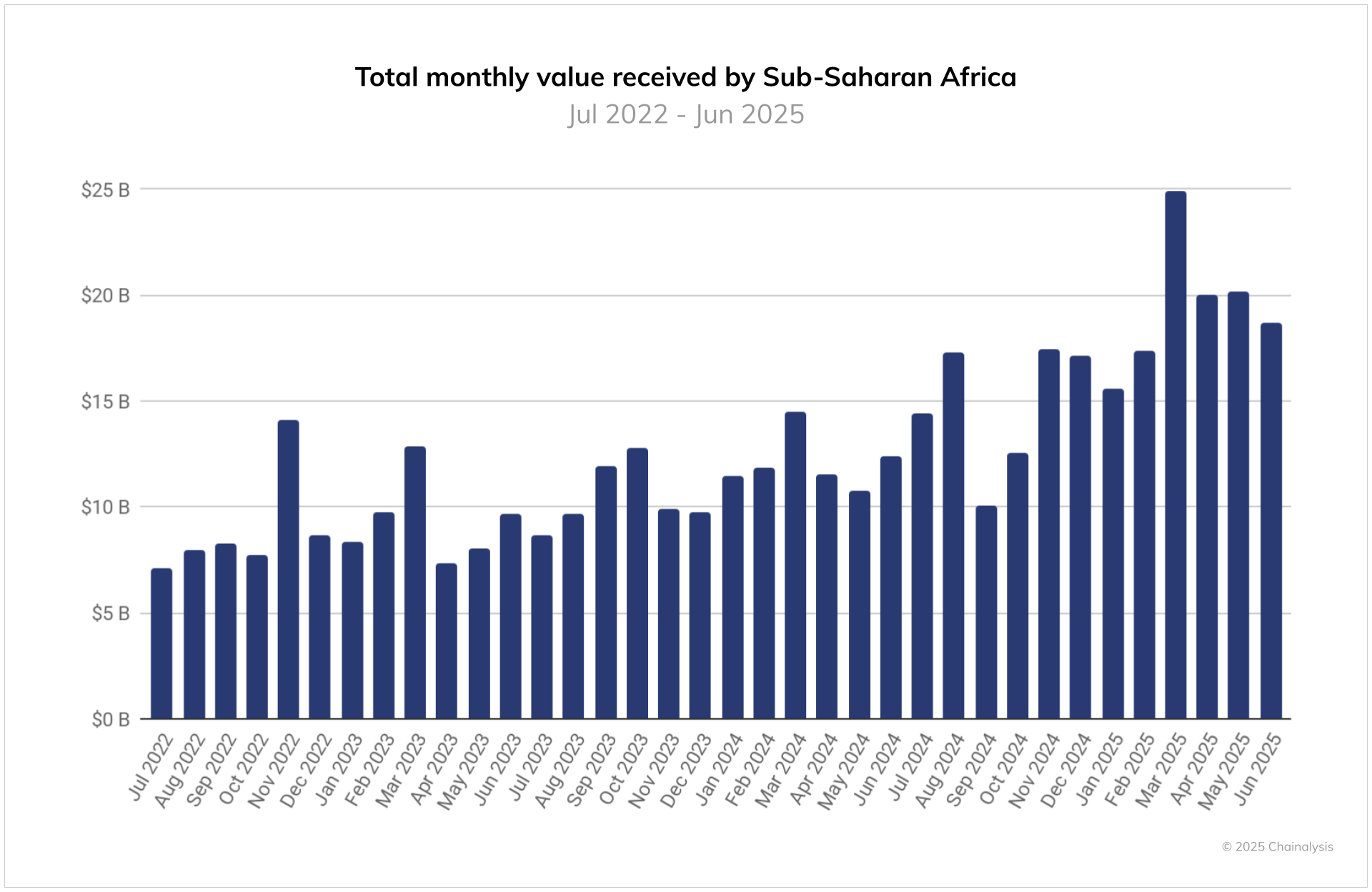
The rise was pushed largely by centralized trade exercise in Nigeria, the place the naira got here underneath renewed forex stress.
Forex devaluation can increase crypto exercise in two methods: customers could flip to crypto to guard their financial savings from a weakening native forex, and current crypto purchases turn into extra invaluable when measured in naira.
Stablecoin fee networks
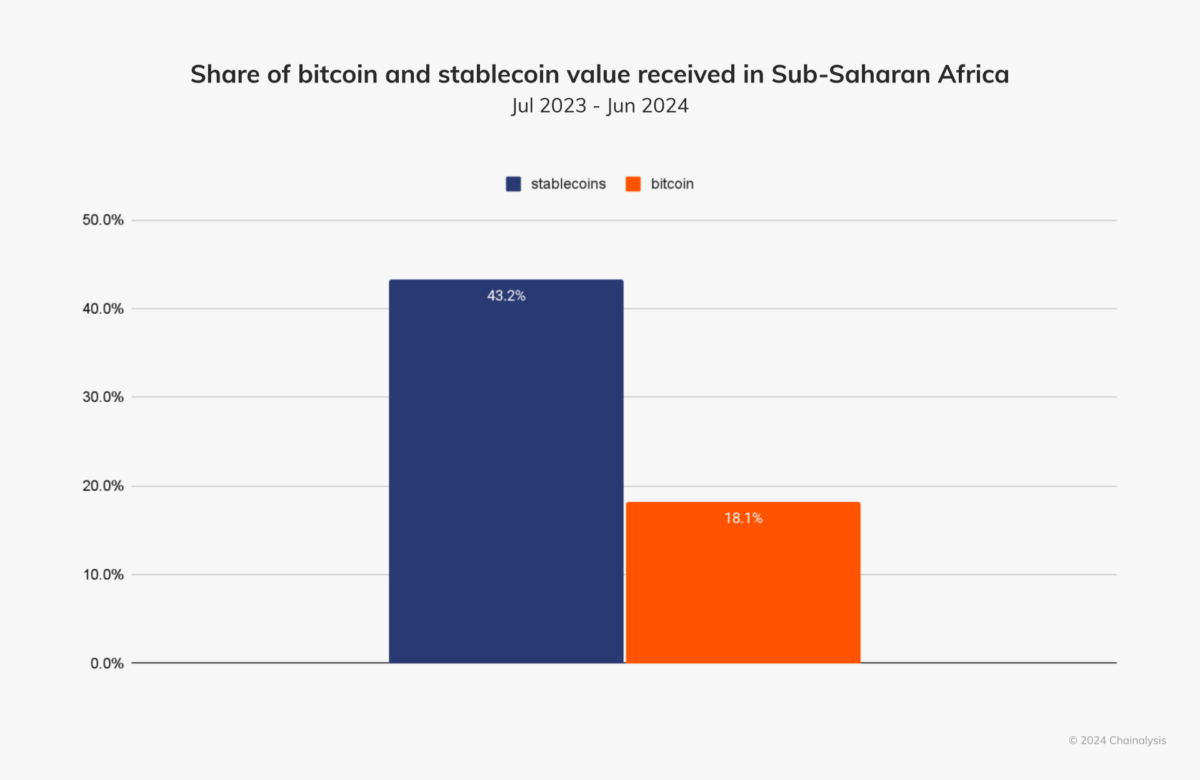
Stablecoins are one other main route for crypto to maneuver throughout the continent. Information reveals that stablecoins accounted for 43% of Sub-Saharan Africa’s whole transaction quantity in 2024.
The movement doesn’t essentially finish in one other crypto pockets. A enterprise or particular person can obtain USDT or USDC after which convert it into native forex. This creates an infrastructure layer between the blockchain and the native monetary system.
For instance, Yellow Card says its fee infrastructure lets companies obtain native fiat, convert it to or from stablecoins, and ship funds through financial institution transfers or cell cash throughout 20 African international locations.
Peer-to-peer markets
Peer-to-peer markets present one other route, significantly the place entry to centralized exchanges or worldwide fee methods is restricted. P2P exchanges accounted for 6% of cryptocurrency transaction quantity in Africa in 2022, greater than twice the share recorded within the next-highest area in that evaluation.

The fundamental mannequin is simple. One particular person desires to purchase crypto, one other desires to promote it, and the platform or fee association connects them. The crypto can transfer between wallets whereas the corresponding local-currency fee occurs by way of a financial institution switch, mobile-money service, or one other native fee technique.
Remittances and cross-border transfers
Cross-border motion is one other essential route. Stablecoins can let somebody exterior Africa ship dollar-denominated worth to a recipient on the continent with out routing the whole transaction by way of conventional correspondent banking channels.
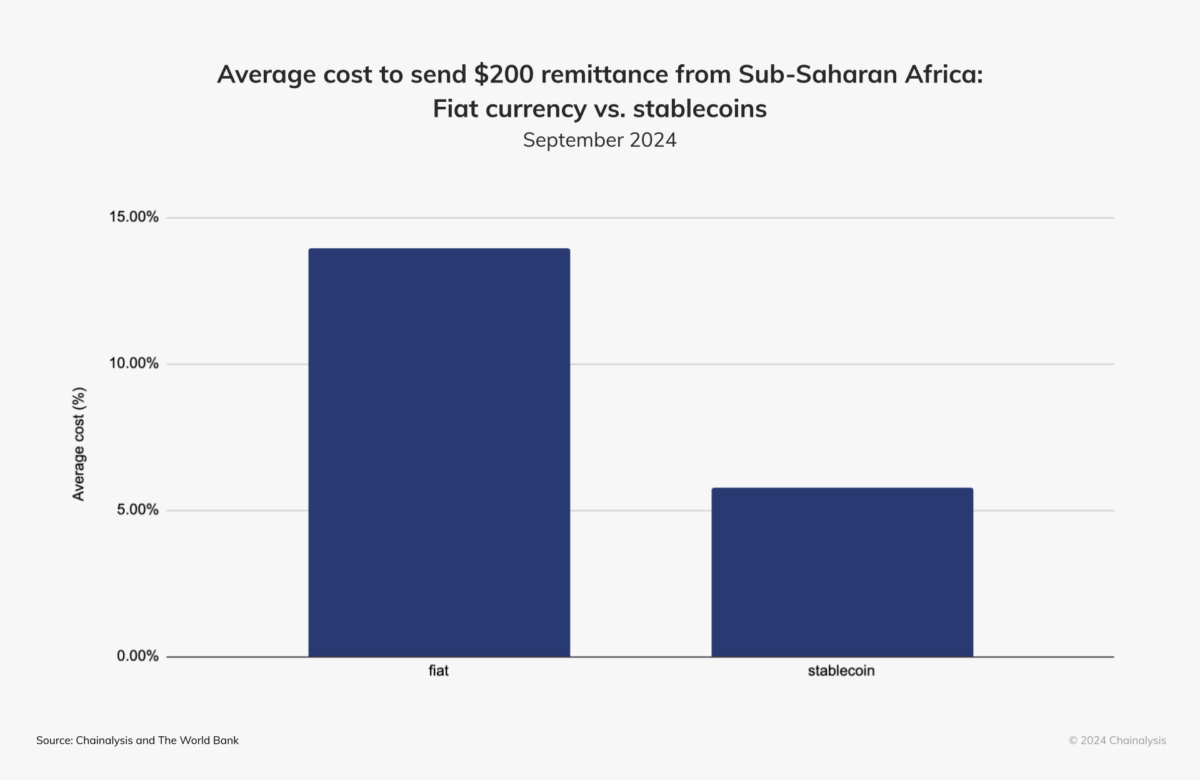
In 2024, the typical value of sending a $200 remittance from Sub-Saharan Africa was about 60% decrease utilizing stablecoins than conventional fiat-based strategies.
The cash normally takes a comparatively easy path: a sender acquires a dollar-pegged stablecoin, sends it to a recipient or middleman in Africa, and the recipient converts it into native forex. The ultimate step can contain a checking account, a mobile-money pockets, or an area crypto off-ramp.
Why Africa’s Crypto Infrastructure Is So Tough to See
The primary cause this infrastructure is difficult to establish is that African crypto exercise typically doesn’t require an African blockchain.
A person in Nigeria can maintain USDT on Tron, obtain USDC by way of one other public blockchain, commerce Bitcoin on a worldwide trade, or ship an asset to a pockets operated by a global firm. The underlying blockchain infrastructure is international. The African element could seem solely when the person converts the asset to naira, pays somebody by way of an area fee technique, or withdraws funds to a Nigerian checking account.
This creates a system through which completely different firms deal with completely different elements of the transaction. The blockchain gives the settlement layer, a worldwide firm could present the crypto service, and an African firm could join the transaction to native cash. Consequently, no single firm or community all the time gives the infrastructure behind African crypto exercise.
For instance, Coinbase built-in Yellow Card’s fee community into Coinbase Pockets, giving customers entry to native fee strategies. Coinbase gives the consumer-facing crypto service, whereas Yellow Card connects to native fee infrastructure.
Crypto exercise usually seems like atypical monetary exercise
A second cause the infrastructure is troublesome to establish is that the crypto element can disappear as soon as a transaction reaches the person’s native monetary system.
Take into account a freelancer or enterprise in Kenya that receives USDC from an abroad shopper. The shopper sends the stablecoin to a pockets or fee supplier, which converts it into Kenyan shillings and sends the cash to the recipient’s checking account or mobile-money pockets. From their perspective, the top result’s merely cash acquired by way of a well-known monetary channel. As soon as the conversion is full, there’s little cause to consider the blockchain behind the transaction.
It is because cell cash and different digital fee methods are already deeply embedded in on a regular basis monetary exercise in Africa. A financial institution department is seen. A card community has a recognizable model. A mobile-money agent has a bodily presence. In contrast, a crypto fee can cross by way of a blockchain, pockets, trade API, liquidity supplier, and native checking account with out the person seeing most of these layers.
The infrastructure could subsequently turn into seen solely when one thing goes flawed, when an organization markets the service behind it, or when researchers hint the transaction on-chain.
Africa’s market is fragmented
Africa is just not one monetary market. The continent has dozens of currencies, separate banking methods, completely different fee networks, and completely different regulatory frameworks. An organization that desires to maneuver stablecoins into native cash can’t merely construct one connection and deal with the whole continent as a single market.
The World Financial institution made the same level in its 2026 report on African financial integration, noting that fee, monetary, digital and different methods often stay fragmented throughout nationwide borders. It particularly requires extra interoperable fee and digital methods to make African markets work extra intently collectively.
Crypto firms face this fragmentation immediately.
An organization supporting customers in Nigeria may have a naira fee connection and to adjust to Nigerian laws. Increasing into Kenya can require a special banking relationship, liquidity in Kenyan shillings, and mobile-money connectivity. Ghana brings the cedi and its personal regulatory atmosphere. South Africa has a extra developed virtual-asset regulatory framework and a special institutional market.
Why Conventional Banking Infrastructure Hasn’t Captured Extra of This Exercise
Conventional banks already course of a big share of Africa’s monetary exercise, however a lot of the crypto financial system sits exterior the methods they have been constructed to function. A cross-border fee can cross by way of a number of banks, correspondent establishments, currencies, and settlement methods earlier than reaching the recipient. For some customers, stablecoins provide an easier various by letting dollar-denominated worth transfer immediately between wallets, with out following the identical path as a traditional worldwide financial institution switch.
Banks additionally face regulatory, compliance, and danger concerns when coping with crypto. Relying available on the market, they might provide restricted help for crypto companies, limit digital-asset transactions, or require extra monitoring of transactions and prospects. This has pushed exercise towards crypto exchanges, fintechs, P2P markets, and stablecoin fee suppliers fairly than immediately by way of financial institution infrastructure.
The result’s a niche between the place monetary exercise is occurring and the place conventional monetary infrastructure is constructed to seize it. Banks stay central to the ultimate motion between crypto and native forex, however they might not management the digital rails the place a lot of the exercise takes place.
The Firms Attempting to Construct Across the Hole
The infrastructure hole has created alternatives for firms constructing between blockchains and Africa’s current monetary methods.
Stablecoin fee infrastructure
Flutterwave is shifting into stablecoin funds from the standard fintech facet. The corporate has been creating stablecoin fee flows utilizing Polygon. This may permit customers to ship and obtain stablecoins whereas connecting these transactions to current fee infrastructure.
The issue is the hole between digital-dollar transactions and native fee methods. A enterprise could obtain USDC from a global buyer however nonetheless have to settle the transaction in an area checking account or one other acquainted fee technique.
Crypto-to-fiat conversion
Platforms resembling Bitnob present infrastructure that connects African companies and customers to Bitcoin, stablecoins, and native monetary methods. Its enterprise merchandise help funds, wallets, and API integrations, together with shifting funds between crypto and native financial institution or mobile-money methods.
Remittance infrastructure
Platforms like Paycrest give attention to the cross-border fee downside from a liquidity perspective. The Nigerian firm describes its platform as a decentralized liquidity community connecting native forex suppliers with stablecoin-based funds. This permits stablecoin transactions to succeed in local-currency markets with out requiring each participant to construct direct banking connections.
Custody and institutional infrastructure
As establishments maintain extra digital property, they want infrastructure to regulate and safe them. VALR, a South African digital-asset platform, has expanded past retail buying and selling into institutional companies. Its institutional providing consists of custody, OTC buying and selling, API integration, multi-account administration, and governance controls. The corporate says it serves greater than 2,000 company and institutional shoppers.
Blockchain-based monetary companies
Blockradar is constructing one other layer of this infrastructure by offering pockets and stablecoin expertise to fintechs. Its platform lets companies combine non-custodial wallets and stablecoin performance with out constructing the underlying blockchain infrastructure themselves.
The importance is that the shopper doesn’t essentially have to know that blockchain is concerned. A fintech can construct stablecoin performance into an current monetary product whereas Blockradar handles a lot of the underlying infrastructure.
The Infrastructure Gaps That Nonetheless Must Be Solved
Africa’s crypto market has grown quicker than the infrastructure wanted to make digital property work seamlessly throughout international locations, monetary methods, and companies.
Cross-border connectivity
Shifting worth between African international locations stays fragmented. An answer that works in Nigeria could not robotically work in Ghana, Kenya, or South Africa as a result of every market has completely different currencies, fee networks, monetary establishments, and laws.
Infrastructure suppliers want interoperable networks that may join these markets and make cross-border crypto and stablecoin transactions simpler to settle in native currencies.
Banking connections
Crypto firms nonetheless rely upon banks and fee suppliers to maneuver cash between digital property and the standard monetary system. Restricted account entry or weak banking relationships could make it tougher to course of native funds, settle transactions, and increase into new markets.
Extra dependable banking and fee connections can provide crypto firms constant entry to native monetary rails with out forcing them to construct separate preparations for each market.
Regulation
Totally different guidelines throughout African international locations make regional enlargement troublesome. Necessities for stablecoins, exchanges, custody, and crypto funds can differ broadly, leaving companies to navigate a number of licensing and compliance methods.
Clearer regulatory frameworks and better consistency throughout markets can provide infrastructure suppliers extra certainty when constructing cross-border companies.
Safety and belief
Customers and companies want confidence within the firms that maintain, convert, or transfer their funds. Questions round reserves, custody, transaction safety, and what occurs when a supplier fails can restrict adoption even when the underlying expertise works.
Stronger custody controls, clear reserve practices, safe transaction methods, and clearer accountability could make crypto infrastructure extra reliable for each people and companies.
Infrastructure for companies
Companies want greater than fundamental crypto fee performance. They want APIs, treasury instruments, accounting methods, and compliance infrastructure that may join digital property with their current operations.
Suppliers have to construct business-focused methods that make crypto simpler to handle alongside financial institution accounts, native currencies, payroll, funds, and monetary reporting.
The Actual Query Behind Africa’s $200 Billion Crypto Move
Africa’s crypto financial system is tougher to see as a result of its infrastructure is unfold throughout international blockchains, exchanges, fintechs, mobile-money networks, banks, and liquidity suppliers. There is no such thing as a single African community dealing with these flows. The $205 billion in crypto worth acquired by addresses in Sub-Saharan Africa between July 2024 and June 2025 reveals that vital demand already exists.
The larger query is who will construct the infrastructure to seize and join that exercise. Firms engaged on stablecoin funds, crypto-to-fiat conversion, liquidity, custody, and enterprise instruments are already addressing elements of the hole. The businesses that may join fragmented markets to dependable native monetary methods could seize the best worth as Africa’s crypto financial system develops.
Disclaimer: This text is meant solely for informational functions and shouldn’t be thought of buying and selling or funding recommendation. Nothing herein ought to be construed as monetary, authorized, or tax recommendation. Buying and selling or investing in cryptocurrencies carries a substantial danger of monetary loss. All the time conduct due diligence.
Loved this? Bookmark DeFi Planet, discover associated matters, and observe us on Twitter, LinkedIn, Fb, Instagram, Threads, and CoinMarketCap Group for seamless entry to high-quality trade insights.
Take management of your crypto portfolio with DEFI PLANET PRO, DeFi Planet’s suite of analytics instruments.