

The U.S. Workplace of the Comptroller of the Forex (OCC) is encouraging group banks to enter the stablecoin market, inviting smaller lenders to use for permission to challenge their very own dollar-pegged tokens forward of the implementation of latest federal rules in January 2027.
In a assertion revealed Monday, October 26, the regulator urged group banks to use straight or by way of subsidiaries to change into licensed cost stablecoin issuers below the Guiding and Establishing Nationwide Innovation for U.S. Stablecoins (GENIUS) Act.
The OCC mentioned the initiative would permit group banks to assist form the way forward for funds. It additionally aligns with its Group Financial institution Comeback initiatives, which intention to tailor regulation and supervision so smaller lenders can develop, compete and proceed serving their communities.
The transfer comes as stablecoins acquire traction in digital funds and conventional banks face rising competitors from cryptocurrency firms.
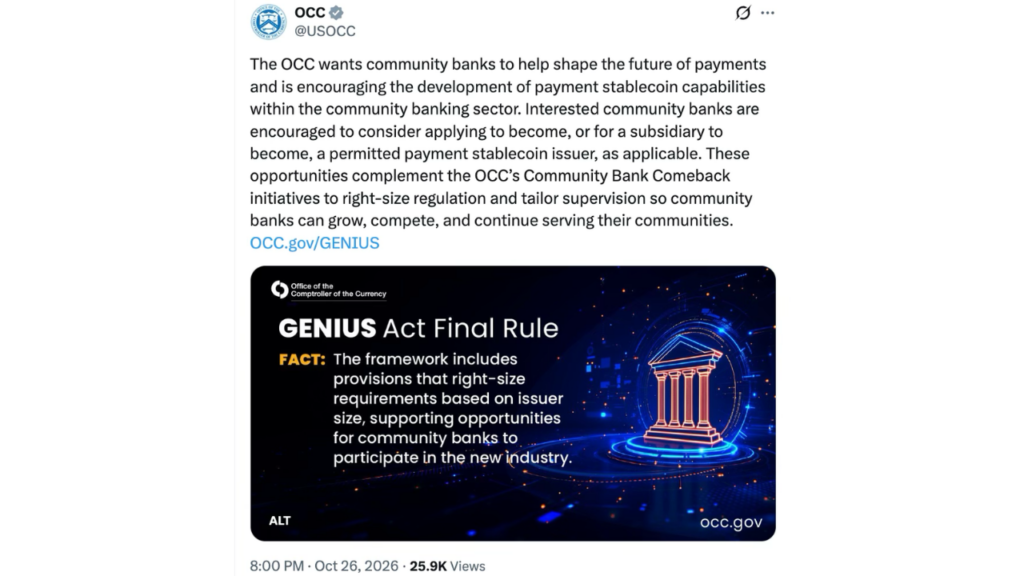
OCC Urges U.S. Group Banks to Enter the Stablecoin Market (Supply: X)
GENIUS Act Units Guidelines for Stablecoin Issuers
Signed into regulation by President Donald Trump on July 18, 2025, the GENIUS Act establishes a federal regulatory framework for cost stablecoins, together with necessities for issuer authorization, reserve belongings and regulatory oversight.
The OCC finalized its implementing rules in October, with the foundations scheduled to take impact on January 18, 2027.
Beneath the framework, issuers should reveal their skill to take care of ample reserves, meet redemption obligations and handle monetary and operational dangers. Necessities additionally cowl capital, liquidity, governance, auditing and regulatory reporting.
Nevertheless, the OCC has not but begun accepting purposes. The method will open after the Workplace of Administration and Finances approves the mandatory federal paperwork.
Current stablecoin issuers could qualify for transitional aid. These submitting considerably full purposes by the January deadline can request momentary waivers permitting them to proceed working whereas regulators evaluate their submissions. The OCC mentioned it typically expects to grant such waivers when acceptable.
For group banks, the framework presents a possible route right into a market more and more related to cryptocurrency firms and bigger monetary establishments. Nevertheless, candidates should reveal that they’ve the programs, monetary assets and danger controls wanted to function as licensed issuers.
Banks Worry Stablecoins Might Drain Deposits
The OCC’s invitation comes amid a dispute between conventional banks and the cryptocurrency trade over stablecoin rewards.
Banking teams have urged lawmakers to limit stablecoin yields, warning that enticing rewards might encourage clients to maneuver cash from standard financial institution accounts to cryptocurrency platforms. Such transfers might weaken banks’ deposit bases and cut back the funds obtainable for lending.
The GENIUS Act prohibits cost stablecoin issuers from paying curiosity or yield solely for holding their tokens. Nevertheless, it doesn’t robotically prohibit each reward program provided by cryptocurrency exchanges or third events.
This distinction has change into a serious level of competition. Banking teams argue that third-party incentives might nonetheless make stablecoins enticing alternate options to conventional financial savings merchandise, even when issuers themselves don’t pay curiosity.
The priority is especially important for group banks, which depend upon deposits to finance loans to households and companies. If clients more and more maintain stablecoins by way of cryptocurrency platforms, smaller lenders might face higher competitors for funding.
Encouraging group banks to challenge their very own tokens might assist them take part in digital funds fairly than lose floor to crypto-focused companies. Nevertheless, coming into the market won’t essentially defend their deposits or assure new income.
The OCC’s closing guidelines additionally don’t require stablecoin issuers to carry their reserves at group banks. Nor should group banks settle for deposits from stablecoin issuers.
The regulator acknowledged that deposits backing stablecoins could possibly be much less steady than conventional deposits, significantly in the course of the market’s early improvement. This uncertainty provides one other consideration for lenders evaluating the potential advantages of issuing digital tokens.
OCC Faces Scrutiny Over Crypto Financial institution Charters
The initiative comes because the OCC faces authorized and political scrutiny over its remedy of cryptocurrency firms.
On October 2, 2026, the Unbiased Group Bankers of America (ICBA) sued the OCC, accusing the regulator of exceeding its authorized authority by granting nationwide belief financial institution standing to crypto-focused corporations.
Conventional banking representatives argue that such approvals might permit cryptocurrency firms to supply sure monetary companies, together with digital asset custody, with out assembly all the necessities relevant to standard banks.
The OCC has distinguished these belief constitution approvals from group banks’ potential entry into stablecoin issuance, noting that crypto-focused belief establishments don’t essentially function below the identical enterprise fashions or present the identical companies as conventional group banks.
Senator Elizabeth Warren has additionally questioned the regulator’s approval of 9 crypto-focused establishments, arguing that some could not meet federal necessities and will pose dangers to the monetary system.
Client safety stays one other concern. A nationwide belief financial institution constitution doesn’t robotically imply clients’ digital belongings are coated by federal deposit insurance coverage, making clear disclosures about regulatory protections important.
These disputes spotlight the problem going through regulators: supporting monetary innovation whereas sustaining acceptable oversight and defending customers.
What Comes Subsequent?
The OCC has finalized its personal GENIUS Act rules, however different federal companies are nonetheless growing components of the broader framework.
The Federal Deposit Insurance coverage Company (FDIC) is engaged on requirements for stablecoin issuers inside its jurisdiction, whereas the Federal Reserve is in search of enter on necessities and approval procedures for banks excited by issuing stablecoins. The Treasury Division can be concerned in growing authorization and supervisory guidelines.
Separate necessities masking buyer identification and anti-money laundering will additional form how issuers function.
For group banks, the OCC’s invitation presents a chance to discover digital funds below a clearer regulatory framework. Greenback-pegged tokens might provide new companies and income streams, however lenders should weigh these prospects in opposition to compliance prices, operational calls for and competitors.
The January 18, 2027, implementation date will probably be a key milestone as banks put together for the brand new necessities.
Whether or not smaller lenders embrace stablecoin issuance stays unsure. Their choices will depend upon buyer demand, business viability and their skill to fulfill federal requirements.
Nonetheless, the OCC’s message is evident: group banks ought to take into account coming into the stablecoin market fairly than depart digital cost innovation to cryptocurrency firms and bigger monetary establishments.


