Key Takeaways
Bitcoin’s 2015 transaction report emerged from an uncommon cleanup of spam-related outputs, whereas at present’s contenders depend on totally completely different strategies.Bitcoin’s exceptionally dense blocks display how specialised minting operations can inflate transaction counts with out producing substantial charges or transferring vital worth.Fashionable transaction engineering is permitting miners to strategy historic information with out altering the community’s 4 million weight-unit restrict.
Bitcoin’s 2015 Transaction File Faces Its Closest Challenger in 11 Years
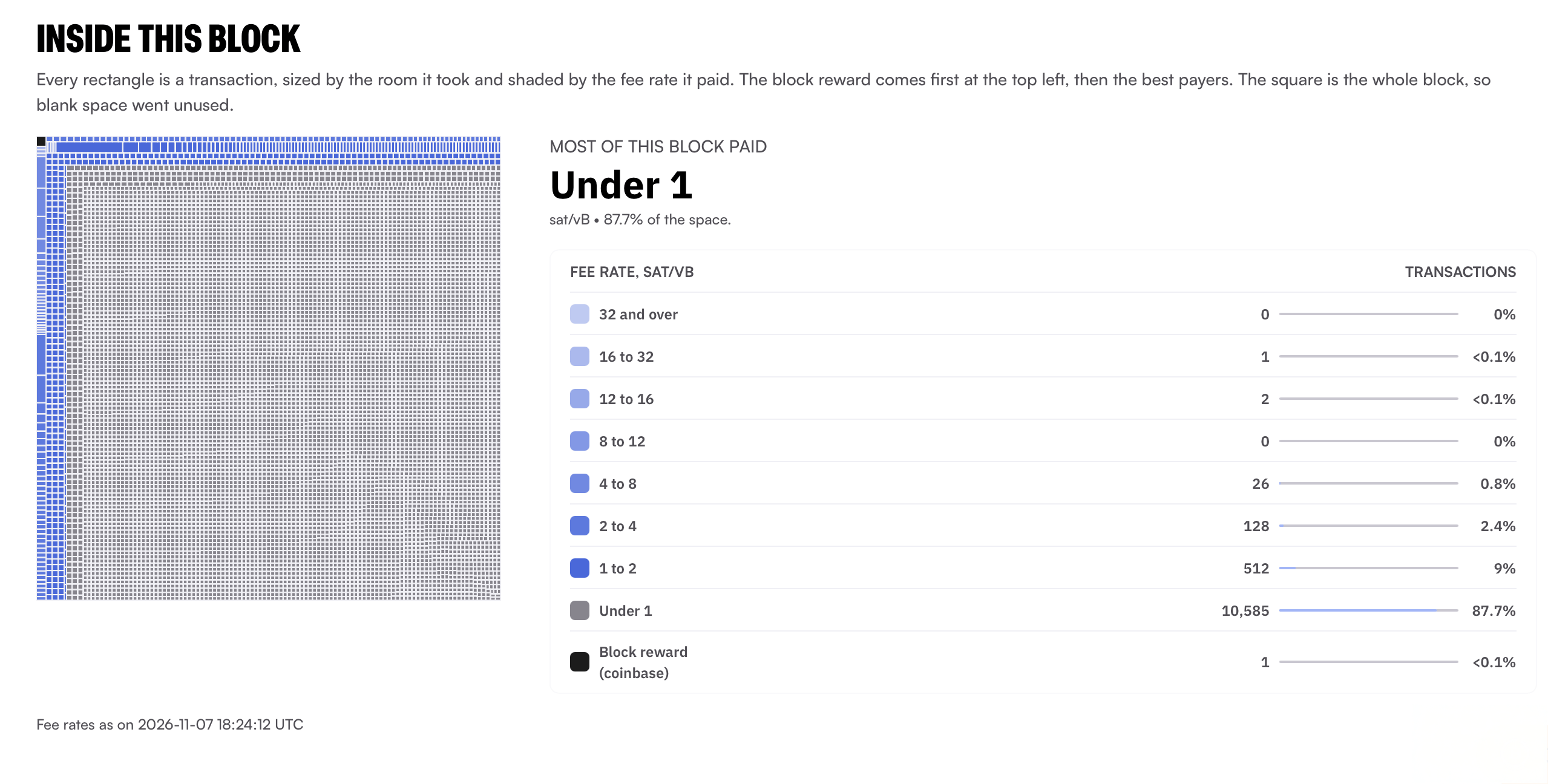
Bitcoin’s transaction historical past is getting a critical exercise in 2026, and the most recent improvement has introduced a seemingly untouchable report again into focus. Block 974961, mined by Antpool on Nov. 7, contained an astonishing 11,255 transactions, inserting it simply 984 transactions behind the all-time report established in August 2015.
The newest milestone follows one other extraordinary block found three days earlier. On Nov. 4, Mempool.area developer Mononaut highlighted the community’s unusually dense transaction exercise in a submit on X, stating:
“Block 974557 contained 10,573 transactions, the second highest determine of all time!”
That distinction lasted solely three days. On Nov. 7, Mononaut returned to X with one other remark, this time documenting a fair bigger assortment of transactions squeezed right into a single Bitcoin block. The Mempool.area programmer mentioned:
“New #2 report: 11,255. We’re quickly closing in on the all-time excessive of 12,239 transactions from block 367853”
The brand new runner-up, block 974961, was mined at 18:24:12 UTC and measured roughly 1.1 megabytes (MB), in keeping with blockchain information. Regardless of accommodating greater than 11,000 transactions, it consumed 3,993,844 weight models, equal to roughly 99.85% of Bitcoin’s most block weight.
Much more curious was the economics behind the achievement. The block collected roughly 0.002405 BTC in transaction charges, a negligible addition to the usual 3.125 BTC block subsidy. Its 11,794 inputs and 23,122 outputs mirrored an unusually massive assortment of compact transactions quite than a procession of standard, high-value bitcoin transfers.
In different phrases, Bitcoin managed to accommodate a rare variety of transactions with out requiring an equally extraordinary quantity of block area or price expenditure.
Why Does a Bitcoin Block From 2015 Nonetheless Maintain the File?
To understand the importance of November’s achievement, one should revisit Aug. 1, 2015, when mining pool F2pool produced block 367853. That block contained 12,239 transactions, a report that has survived greater than 11 years of technological modifications, community upgrades, and fluctuating transaction demand.
Not like at present’s Bitcoin blocks, which function below a 4 million weight-unit restrict, the 2015 block was constrained by the unique 1 MB dimension ceiling. F2pool however managed to pack 12,239 transactions into roughly 999.96 kilobytes, an distinctive feat below the community’s earlier structure.
The circumstances have been hardly unusual. Bitcoin was enduring a interval of what some known as spam assaults or deliberate community stress exams, together with reported campaigns that generated monumental portions of tiny, low-value transaction outputs.
The exercise additionally introduced renewed consideration to Bitcoin’s unspent transaction output (UTXO) set, which grew to become one other level of debate within the broader debate over community effectivity, scalability, and block dimension limits.
A UTXO represents bitcoin obtained via a earlier transaction that continues to be out there to spend. Each Bitcoin full node should keep details about these unspent outputs to find out whether or not subsequent transactions are legitimate and whether or not the identical cash are being spent twice.
Throughout the 2015 UTXO waves, monumental portions of mud outputs accrued throughout the community. F2pool subsequently undertook cleanup efforts that consolidated these outputs, lowering the variety of particular person entries nodes wanted to trace.
Block 367853 emerged from that uncommon episode. Quite than containing 1000’s of unusual monetary transactions, it included exceptionally small, nonstandard transactions, some measuring roughly 62 bytes, permitting the miner to maximise the variety of transactions contained in the out there area.
F2pool additionally mined block 367851 that day, containing 9,647 transactions. Collectively, these blocks demonstrated how miners may assemble unusually dense blocks utilizing transactions that will not ordinarily propagate via customary community relay channels.
The 2015 report was due to this fact a product of specialised transaction engineering and community housekeeping, not merely overwhelming shopper demand for bitcoin funds.
How Segwit and Runes Are Pushing Bitcoin’s Transaction Limits
Quick-forward to 2026, and the mechanics behind Bitcoin’s densely packed blocks look significantly completely different. A lot of the latest exercise includes extremely compact transactions related to the Runes protocol, notably minting exercise involving UNCOMMON•GOODS, the primary rune launched round Bitcoin’s fourth halving in April 2024.
These transactions can use light-weight pay-to-anchor (P2A) outputs and thoroughly optimized constructions, generally measuring roughly 80 to 100 digital bytes. Their modest dimension permits miners to suit 1000’s extra transactions right into a block than could be attainable utilizing bigger, standard transaction codecs.
One other necessary ingredient is Segregated Witness (Segwit), Bitcoin’s August 2017 improve that separated transaction signature information from the knowledge used to calculate conventional transaction identifiers. Segwit launched block weight, permitting witness information to rely much less closely towards Bitcoin’s capability restrict.
The excellence issues as a result of Bitcoin’s transaction capability can’t be measured just by counting bytes. Two blocks consuming comparable weight can include dramatically completely different transaction totals relying on their contents.
That helps clarify why block 974961 may accommodate 11,255 transactions whereas amassing just about nothing in charges. The record-setting rely displays transaction effectivity and specialised protocol exercise, not essentially an equal improve in financial demand.
The event additionally raises an necessary distinction between transaction throughput and precise financial settlement. A blockchain processing 1000’s of small token-related operations is just not essentially transferring extra bitcoin worth than one processing considerably fewer, bigger monetary transactions.
Seven of Bitcoin’s 10 Busiest Transaction Days Occurred in 2026
The extraordinary block counts are usually not remoted curiosities. Bitcoin’s every day transaction information inform a equally compelling story, with seven of the ten busiest days within the community’s historical past occurring throughout 2026.
The all-time every day report stays April 23, 2024, when Bitcoin processed 927,010 transactions shortly after the fourth halving and the introduction of Runes. Nonetheless, Oct. 23, 2026, got here exceptionally shut, recording 913,196 transactions, simply 13,814 in need of the historic peak.
October additionally delivered one other main milestone on Oct. 5, when the community processed 904,518 transactions. Further entries from July, August, September and June display that 2026’s elevated exercise prolonged throughout a number of months quite than originating from one remoted episode.
But November has launched an intriguing contradiction.
Throughout the first seven days of the month, the Bitcoin protocol averaged roughly 534,200 transactions every day, roughly 25% under October’s common of 710,400. On Nov. 2, every day exercise fell to 381,886 transactions, the bottom studying since March 17.
The slowdown coincided with appreciable turbulence throughout cryptocurrency markets following the late-October Binance safety breach and subsequent declines in bitcoin’s market value.
However, the community produced its second-largest transaction block on Nov. 7, when every day exercise recovered to 591,830 transactions.
This distinction illustrates why particular person block information and every day transaction totals ought to be interpreted individually. A miner can assemble an exceptionally dense block containing specialised transactions even when general community exercise is working under its latest averages.
Will Bitcoin Lastly Break Its 12,239-Transaction File?
The remaining distance between Bitcoin’s latest milestone and its historic report is surprisingly slim. One other 985 transactions past November’s second-place block would set up a brand new all-time excessive.
Whether or not that occurs relies upon much less on standard bitcoin fee demand than on the continued manufacturing of exceptionally compact transactions and miners’ willingness to incorporate them.
The broader image is equally revealing. Bitcoin’s busiest transaction days more and more mirror specialised blockchain functions, whereas conventional financial exercise represents just one part of whole community utilization.
For now, the 2015 report stays intact, however its longevity now not makes it seem untouchable. Eleven years after F2pool stuffed a block with 1000’s of unconventional transactions, fashionable miners are approaching the identical territory via totally completely different technical strategies. The competition demonstrates that Bitcoin’s transaction rely is as a lot a operate of how transactions are constructed as how often the community is used.