

“Wow. Are you able to hear the bombing?” Riad Al-Assaad asks The Artwork Newspaper, talking from his village of Zrariyeh in southern Lebanon. An Israeli strike on a close-by village cuts brief a dialog about his efforts to avoid wasting what stays of the heritage within the nation’s south: scanning its previous buildings, recording its oral historical past and now rescuing its libraries. Regardless of a ceasefire, south Lebanon stays beneath Israeli occupation and at warfare, and its folks say their historical past is being erased.
The south has lived with Israeli invasion and occupation for almost half a century. Israel invaded in 1978 and pushed north to Beirut in 1982, the yr Hezbollah fashioned to battle it, and it didn’t withdraw from the south till 2000. In 2006, the 2 fought a month-long warfare after Hezbollah captured two Israeli troopers in a cross-border raid.
The current battle started on 8 October 2023, the day after the Hamas assaults on Israel, with exchanges of fireplace between Hezbollah and Israel. It escalated in September 2024 into full-scale warfare, with an Israeli floor invasion and strikes on Beirut, earlier than a ceasefire that November. Combating resumed in March 2026, when Hezbollah fired on Israel after the US and Israel attacked Iran; a ceasefire settlement reached in US-led talks in June has not ended it. Strikes proceed each day, and Israeli forces occupy round 600 sq. km of the south, reaching as much as 10km into Lebanon, behind what the military calls the Yellow Line.
Zrariyeh has round 2,000 homes, Al-Assaad estimates. By his rely, 65 have been destroyed on this warfare and greater than 100 broken. His father’s home, in the midst of the village, was hit twice: first by shrapnel, then by blasts that “levelled” neighbouring buildings and blew out its home windows and doorways. Like others who’ve repaired their properties “as soon as, twice, 3 times”, he now covers the openings with plastic. “We live within the nylon period,” Al-Assaad says. However what’s at stake, he provides, is “our historic existence”.
Probably the most seen a part of that historical past is the south’s historic monuments, and worldwide safety has not saved them secure from the warfare. Since 2024, Unesco has granted 73 websites throughout Lebanon enhanced safety, which prohibits focusing on them or utilizing them for navy functions. In July, it inscribed the 5 castles of Mount Amel, all of them granted enhanced safety, on its World Heritage Record and its record of websites in peril. Three of the castles, Beaufort, Dubieh and Chama’, are beneath Israeli occupation. Days after the inscription, the Israeli navy detonated 700 tonnes of explosives about 800m from Beaufort, claiming it was destroying Hezbollah tunnels. In Tyre, a World Heritage Web site since 1984, strikes have broken columns, mosaics and the location’s places of work and shops.
Ali Badawi, the ministry of tradition’s regional director for south Lebanon, says his groups can not attain the occupied websites and depend on low-resolution satellite tv for pc photographs and pictures launched by the Israeli military. One broadcast confirmed Israeli troopers in Beaufort’s historic halls watching the Fifa World Cup on televisions he believes have been taken from the citadel’s info centre. Unesco has allotted some funding for the restoration of Tyre, however elsewhere donors are holding again whereas the warfare continues. “We can not do something for the time being,” Badawi says. “We have now to attend.”
Badawi lives in a village south of Tyre, near Al Mansouri, an space that he says Israeli forces strike each day. “Typically at evening we don’t sleep, as a result of it’s simply explosion after explosion,” he says.
‘Always afraid, unsettled and distracted’
His colleague, Mohana Chahine, who manages the artefact shops at Tyre’s Al-Bass web site, was severely injured in an Israeli drone strike on 14 August 2024, weeks earlier than the warfare escalated. She was driving dwelling along with her husband when a missile was fired at a bike behind them, shattering the automobile’s home windows and leaving her unable to maneuver. Her husband pulled her from the automobile, and a second strike threw them each away from it. After a month in hospital and additional remedy in France, Chahine has accomplished her PhD and returned to work. “I’m going to work actively, however I’m continuously afraid, unsettled and distracted,” she says. “I’m continuously anxious about one other warfare or being injured once more.”
Past Tyre and the castles lies heritage that seems on no Unesco record: the previous homes, mosques, church buildings and cemeteries of southern Lebanon’s villages. Joanne Farchakh Bajjaly, an archaeologist and former journalist, is the founding father of Biladi, a heritage organisation that has monitored the south since October 2023. In 2025 it recorded 389 historic buildings in 5 villages—in keeping with Biladi, 85% of them are actually destroyed. It was making ready to publish a report final March, however the return of warfare halted that venture and Biladi widened its survey as an alternative. With structure college students from the Lebanese College, the organisation logged round 850 websites throughout 105 villages, occupied or beneath menace, from archaeological ruins to homes constructed earlier than 1950. The complete findings are being held for its delayed report, however Biladi shared a few of them with The Artwork Newspaper. Amongst them: the lack of the realm’s Shia non secular websites—mosques, shrines, mausoleums or husseiniyas (halls for non secular gatherings)—stands at round 98%.
The 18th-century St George’s Melkite Catholic church in Dardghaya within the Tyre district was severely broken in Israeli assaults in October 2024 Picture: courtesy Biladi
In July Israel’s defence minister, Israel Katz, mentioned the military had fully destroyed 24 villages that have been “a whole lot of years previous”, totalling 15,000 to twenty,000 properties, by his estimate. Lebanese counts are larger.
“We have now 38 villages which have been bulldozed to the bottom. Nothing stays,” Bajjaly says, including that villages nonetheless beneath assault, corresponding to Al Mansouri, haven’t but been assessed and the determine might rise. Badawi places the whole variety of villages destroyed at round 50. Every village has an historic centre constructed over older stays, he notes, a few of them Byzantine, Roman or Phoenician, so the loss can’t be counted in properties alone. “It’s not only a matter of variety of homes. The historic cloth itself is destroyed.”
In response to each Badawi and Bajjaly, historic cemeteries throughout southern Lebanon have additionally been bulldozed by Israeli forces. At shrines, Bajjaly says, the earth has been turned over and the useless dug up. “That is whole desacralisation, and these are well-calculated gestures,” she says.
Olive timber have been destroyed, too. After seeing photographs of timber being uprooted, Badawi went to Naqoura in early 2025 and located a area stripped of its previous timber. In September a French Lebanese businessman filed a lawsuit in France accusing the Israeli navy of warfare crimes, alleging that 600 timber his household had cultivated for 250 years have been uprooted and brought to Israel. “After they take away 500-year-old olive timber, this isn’t anymore a problem of safety,” Al-Assaad says.
The intention, Bajjaly believes, is “to kill the connection between the folks and their land and their historical past, and subsequently to make it clear for them that there’s no return”.
The artist Oussama Baalbaki is aware of all too effectively what which means. His late father, the famend painter Abdel Hamid Baalbaki, started constructing the household’s home of their ancestral village of Odaisseh, near the border, in 1984, two years after Israel’s invasion of Beirut displaced them. With the village beneath occupation, his dad and mom constructed it “over a really lengthy interval, with restricted monetary means and amid occupation, recurring warfare and displacement”.
His father, an beginner collector, hoped the house would change into “one thing like a museum, or a cultural centre for literature and poetry”, and stuffed it with manuscripts, uncommon books, sculptures, work and antiquities. “Most vital of all, the home shelters, beneath the timber of its backyard, the tomb of my mom and father,” Baalbaki says.
In October 2024 the home was “rigged with explosives, together with each neighbourhood of the village, in a scientific, annihilating method”, Baalbaki says of the detonation, which was captured on video. His siblings visited the ruins in February 2025 to salvage what they might, however the village is now occupied and out of attain. “We misplaced our connection to the land of our ancestors,” he says, “and have been left wandering in a torn house of creativeness and time.”
The home had seemed out over a valley in the direction of a naked plateau, a view that formed two generations of work. “This pure horizon imprinted itself on my father’s work and, in time, handed into my very own,” Baalbaki says.
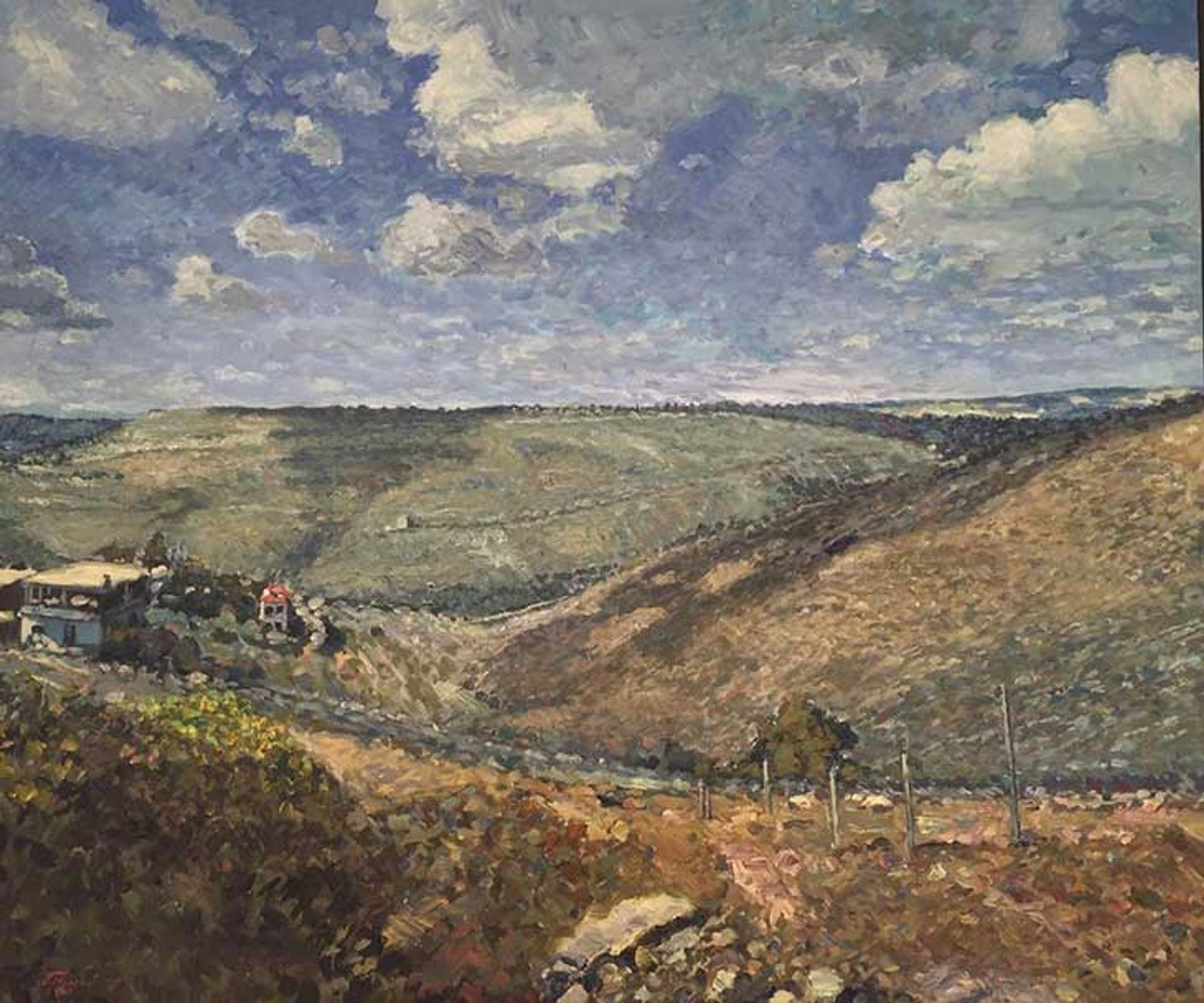
A 2017 portray by Oussama Baalbaki of his village of Odaisseh and household dwelling, destroyed in 2024 Courtesy the artist
In Al Qantara, the household village of the artist and film-maker Ahmad Ghossein, the panorama itself has gone. His father returned there when the Israeli occupation resulted in 2000, constructed a home and retired amongst his olive timber and chickens. When preventing started in 2023, he refused to go away, answering his son’s pleas from Beirut with images and movies.
“He was sending me on a regular basis photographs of the dawn, each morning, to say, ‘I’m high-quality’,” Ghossein says. He held out till September 2024, and even then went again each time a ceasefire allowed. This March, Ghossein says, the village was blown up by Israeli forces and the hill it stood on levelled. “It’s not that you simply don’t discover your own home, you don’t discover the land. It turned white sand.”
Ghossein has made his father’s each day images, movies and WhatsApp voice notes right into a four-screen video set up, The Sound of Silence. It was proven on the Beirut Artwork Middle and at Frieze London in October, and is because of be proven at Artwork Jameel in Jeddah. The footage is as his father shot it: the backyard, the chickens, the street to the village, by no means the warfare. The query behind the piece, Ghossein says, is: “Are you able to do one thing about a spot that doesn’t exist anymore?” His father, who now lives in Beirut, is “misplaced, roughly”, going through the fact that he could not return for a very long time.
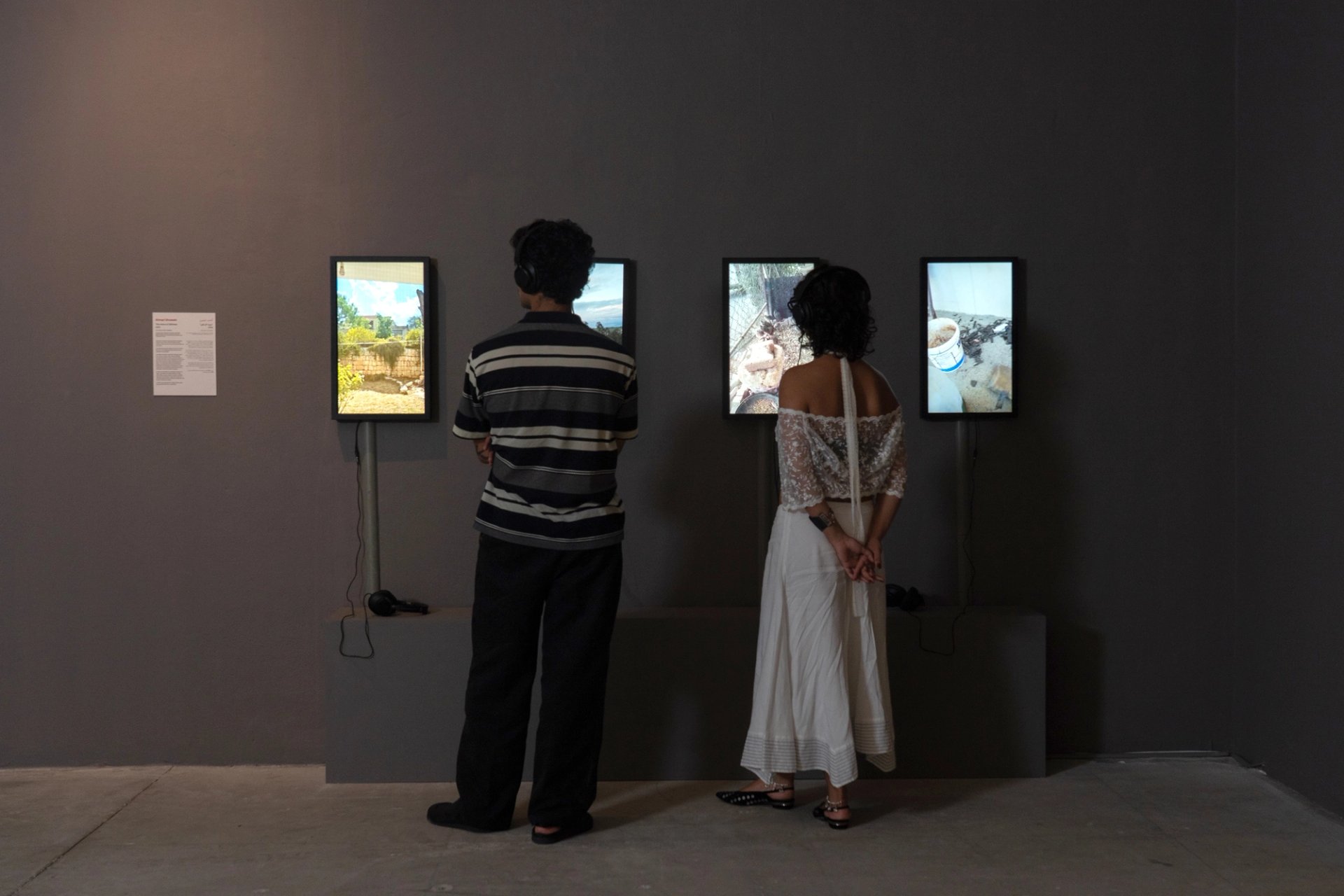
Installtion view of Ahmad Ghossein , The Sound of Silence
© Ahmad Ghossein. Courtesy: Beirut Artwork Centre
However Ghossein refuses to be forged as a sufferer. “Sure, it’s horrible. Sure, it’s a catastrophe. Sure, they’re erasing,” he says. “However I’m simply persevering with. It is a resistance by itself.”
Rescuing non-public libraries
Al-Assaad’s reply is to avoid wasting what can nonetheless be carried or recorded. He owns a development firm, which in wartime turns into “like a civil defence firm”, handing out meals, drugs and gasoline. Working with the tradition ministry, he provides architectural scans of previous mosques and homes within the border villages. “We will’t take away them. We will’t sandbag them,” he says, however they are often documented for future generations.
With Biladi he’s now additionally rescuing non-public libraries: household collections handed down by means of generations. In Zibqin, often called the village of poets, they’ve discovered round 20. The 2 largest have been misplaced beneath rubble; one in all them, with round 6,000 books, was burned by an incendiary bomb, he says. From one other broken dwelling the group is recovering as much as 2,000 volumes, lots of them handwritten. Every ebook is cleaned, photographed, catalogued and moved to secure storage till its proprietor can reclaim it. He’s interesting to anybody within the south with a library in danger to get in contact. “We don’t have the luxurious of time,” he says. “We don’t have the luxurious of doubt.”
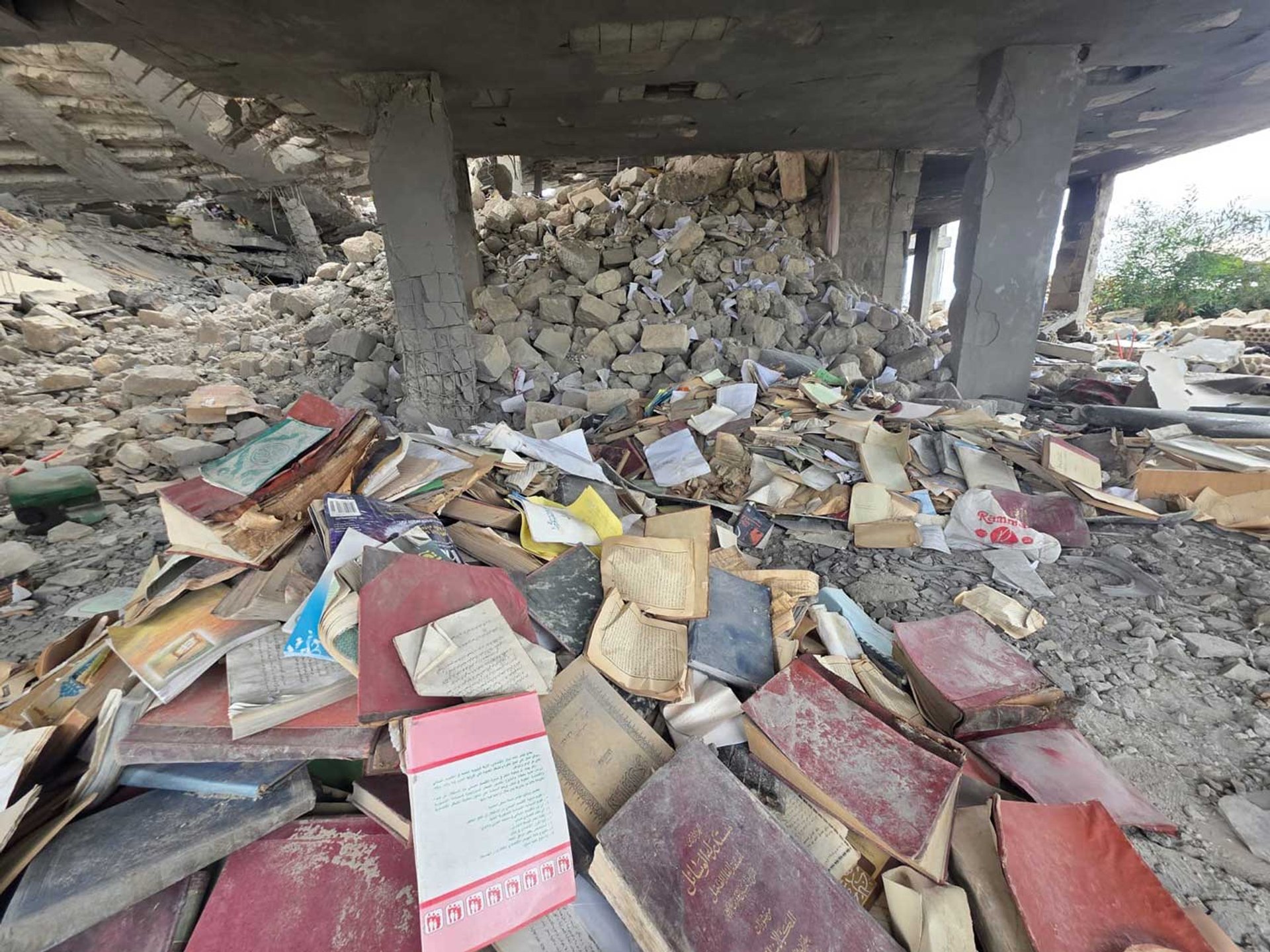
A destroyed dwelling with a non-public library, containing manuscripts and historic books, in Zibqin, often called the village of poets © Riad Al Assaad
Bajjaly fears what occurs to a folks’s previous when nothing bodily is left to carry it. “Is the historical past of south Lebanon going to show right into a fable? ‘We had a home right here. We had a mosque right here’,” she says. Documentation is her reply, a means “to provide again to the inhabitants a proof of their very own existence”. Biladi’s survey will go to the ministry of tradition, which she says is urgent for heritage to be a part of any rebuilding. “Any plan of reconstruction for south Lebanon that doesn’t embody heritage could be a continuity of the destruction,” she says.
Baalbaki says the uprooting shall be non permanent. “We’ll return to our land. However with what creativeness will we return, and to what panorama?”


