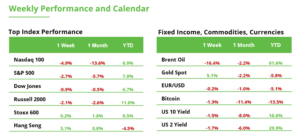
Markets are getting choppier, however the weak spot is uneven. Huge tech is dropping momentum whereas healthcare, financials and components of the patron sector present resilience. For traders, the query is whether or not these rising leaders can face up to a broader selloff.
Promoting will get louder
Thursday introduced a broad retreat: roughly seven shares fell for each one which rose, the weakest studying since October 2025. Traders additionally stepped up demand for cover in opposition to additional losses.
Nerves alone don’t sign a backside. Sentiment has cooled, however the S&P 500 and Nasdaq 100’s weakening traits counsel {that a} rebound would want extra proof behind it.
The common inventory holds up higher
Measurement issues. The equal-weight S&P 500, which provides every firm the identical affect, is holding up higher than the tech-heavy Nasdaq 100. It outperformed the standard S&P 500 by 3.2% by means of October.
Why that issues: market returns may turn out to be much less depending on a handful of giants. Traditionally, this sort of relative energy has usually continued into the next 12 months, though outperformance can nonetheless imply dropping much less in a falling market.
Healthcare takes the lead
The hole is putting: 90% of S&P 500 healthcare shares have been above their common worth over the previous 200 buying and selling days, in contrast with simply 37% of expertise shares.
Financials are enhancing too, together with shopper shares, exhibiting encouraging momentum, though their longer-term traits want extra work.
Power hits turbulence
One other weak spot: refiners have shortly fallen round 20% from their highs, whereas smaller vitality firms are additionally struggling. Current weak spot challenges vitality’s place among the many market’s stronger sectors.
Funding takeaway: Use altering management to assessment focus. An equal-weight method can unfold publicity past the biggest expertise firms, whereas healthcare’s resilience and enhancing financials warrant nearer consideration. Client shares want extra affirmation, and vitality’s weak spot argues for selectivity. Preserve the excellence between relative energy and safety: sectors holding up higher can nonetheless fall in a broader selloff. Favour companies with dependable money era, manageable debt and affordable valuations. Rebalance progressively, leaving room so as to add if broader market energy develops, fairly than treating the primary rebound as affirmation that the correction is over.
US Midterm Elections Outcomes: Implications for Traders
The US midterm elections may carry vital adjustments for knowledge centres, healthcare, defence and monetary coverage. A divided Congress might make it more durable to cross main laws, however adjustments on the state degree and negotiations over authorities spending may nonetheless have a significant influence on sure sectors.
Information facilities: Political dangers usually are not absolutely priced in
The political surroundings is turning into much less beneficial for data-centre growth. Each Democrats and Republicans are more and more questioning new tasks, notably on the state degree.
Texas: Round 25% of the US data-centre growth pipeline is linked to the state. A proposed moratorium on new tasks may put a big quantity of deliberate capability in danger.
Georgia and Ohio: New governors may introduce increased taxes and tighter restrictions on data-centre development.
Federal coverage: Democrats may push to take away a tax break that lets data-centre firms deduct their funding prices instantly, making new tasks dearer.
What it means for traders: Increased taxes, fewer tax advantages and tighter development guidelines may make new knowledge centres dearer to construct and fewer worthwhile.
Information-centre shares have already mirrored a few of these considerations since July, however the dangers will not be absolutely priced in.
We expect that the influence might differ throughout firms. Restrictions on new knowledge centres may make current computing capability extra helpful, probably benefiting hyperscalers akin to Microsoft, Amazon and Alphabet, which already function giant data-centre networks. Then again, builders akin to IREN, Utilized Digital and Hut 8 may face delays and better prices as they construct new amenities. Chipmakers akin to Nvidia and AMD, together with cooling and electrical tools suppliers like Vertiv and Eaton, may additionally face slower demand if fewer knowledge centres get constructed.
The important thing distinction is between firms that have already got computing capability accessible and people counting on new knowledge centres being constructed.
Healthcare: Extra regulation, however main adjustments could also be troublesome
Healthcare is more likely to be one of many first priorities for Democrats. They’re anticipated to give attention to defending Medicaid funding and bringing again Reasonably priced Care Act subsidies, which assist individuals afford medical health insurance.
On the similar time, proposals to decrease drug costs and introduce tighter guidelines for Medicare Benefit are more likely to return.
What it means for traders:
Hospitals: Defending healthcare protection may imply extra insured sufferers and fewer unpaid medical payments, supporting hospital funds.
Well being insurers: Corporations with giant Medicare Benefit companies may face stress from tighter guidelines and potential adjustments to funds.
Prescription drugs: Renewed efforts to decrease drug costs may put stress on earnings and share costs.
Many of those proposals might by no means turn out to be legislation. Nonetheless, even the prospect of more durable regulation may weigh on investor sentiment.
The important thing level is that healthcare shouldn’t be handled as one sector. Hospitals may gain advantage from better insurance coverage protection, whereas insurers and drugmakers face completely different dangers.
Defence: Increased spending could also be more durable to ship
The administration is more likely to push Republicans to lift the debt ceiling and approve increased defence spending earlier than Democrats take workplace.
Nonetheless, reaching an settlement might show troublesome.
What it means for traders: Defence firms have benefited from expectations of upper army spending, however these will increase might take longer to materialise than anticipated.
This doesn’t essentially imply defence budgets will fall. The larger threat is that spending rises extra slowly than traders anticipate.
Corporations counting on new authorities contracts might be extra uncovered to delays, whereas these with established, long-term contracts could also be higher protected.
Fiscal coverage: Extra political gridlock
A divided Congress may make negotiations over authorities borrowing, spending and taxes tougher.
The debt ceiling may turn out to be an vital bargaining device, with Democrats probably demanding adjustments to tax advantages in change for supporting a rise.
What it means for traders: The influence could also be better for particular person sectors than for the general inventory market.
Corporations that rely closely on tax incentives or authorities spending may face extra uncertainty. Information centres are one instance, given the potential elimination of their upfront tax deductions.
Even when proposed adjustments by no means turn out to be legislation, uncertainty may make firms extra cautious about committing to giant investments.
The potential market shock: AI development faces political obstacles
Traders have spent a lot of the previous 12 months asking whether or not firms are spending an excessive amount of on AI and whether or not these investments will generate ample returns.
A distinct threat is now rising: what if firms need to construct extra AI infrastructure however face rising political obstacles?
Increased taxes, restrictions on development and delays in approvals may sluggish data-centre growth even when demand for AI continues to develop.
This might create divergences throughout the sector.
Corporations that already function knowledge centres, have entry to electrical energy and maintain the required approvals might be in a stronger place. Builders that also must construct giant quantities of recent capability might face increased prices and delays.
Nonetheless, current operators wouldn’t be fully protected, notably if increased taxes and working prices have an effect on the entire business.
The funding query is whether or not markets have absolutely accounted for the likelihood that political restrictions, fairly than weak demand, may sluggish AI infrastructure development.
Most important Funding Takeaways: The elections may carry completely different dangers and alternatives throughout sectors.
Information centres: Increased taxes and tighter growth guidelines may put additional stress on shares, with some dangers not but absolutely priced in.
Healthcare: Hospitals may gain advantage from efforts to guard insurance coverage protection, whereas drugmakers and Medicare Benefit insurers face the prospect of more durable regulation.
Defence: Increased army spending might take longer to ship, making a threat for firms the place expectations are already excessive.
Fiscal coverage: Debt-ceiling negotiations may create uncertainty round authorities spending and current tax advantages.
The broader funding takeaway is that political adjustments don’t must turn out to be legislation to have an effect on markets. The prospect of upper prices, tighter regulation or delayed spending can affect firm funding plans and share costs effectively earlier than any ultimate choice is made.
For traders, the vital query is which dangers are already mirrored in valuations and the place there should be room for disappointment,
Nasdaq 100 in Correction Territory – Shopping for Alternative or Warning Sign?
The Nasdaq 100 fell 5.5% final week to round 26,900 factors and closed under its 50-week transferring common at 27,480 factors.
A weekly shut under the 50-week transferring common is especially vital for 2 causes. First, it occurs comparatively not often. Second, related conditions lately usually created enticing entry alternatives. The important thing query now could be how lengthy the index will stay under the transferring common.
The chart exhibits that the length can differ considerably, as illustrated by the purple rectangles. After the 2020 coronavirus crash and Trump’s tariff bulletins in 2025, the Nasdaq 100 recovered comparatively shortly and resumed its uptrend. In 2022, nevertheless, the index remained under the 50-week transferring common for longer throughout a gradual, multi-wave sell-off.
Traders ought to subsequently look ahead to reversal indicators. A transfer again above the July low at round 27,060 factors, adopted by a return above the 50-week transferring common, may assist stabilise the market. Till that occurs, the chance of additional declines stays.
The Nasdaq 100 is at present round 14% under its file excessive and is subsequently formally in correction territory. Crucial help degree is the double prime shaped in January at 26,250 factors. This space was already examined final week. If it fails to carry, the subsequent vital degree is far decrease, on the March low of round 22,800 factors.
Nasdaq 100, weekly chart. Supply: etoro
Might Q3 Outcomes Set off a Breakthrough for Siemens Power?
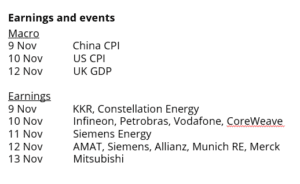
Siemens Power will publish its Q3 outcomes on Wednesday. After the current market turmoil, the inventory has turn out to be a check of the resilience of main traits akin to infrastructure, AI and geopolitics.
The correction in US expertise shares was pushed by considerations that tech firms may reduce their large infrastructure investments as returns from AI take longer to materialise. Siemens Power provides transformers and grid expertise for knowledge facilities, making it a key bottleneck within the AI growth.
Following the Democrats’ election victory, native moratoriums on data-center development are a threat within the US. Throughout the earnings name, traders ought to subsequently pay attention carefully for any indications of delays to main US tasks. Persistently excessive bond yields are additionally related. Siemens Power’s prospects, together with grid operators, utilities and wind-farm builders, usually finance multibillion-euro tasks over a few years. Increased financing prices may sluggish these tasks down.
The inventory fell 6.4% final week to €118.40 and quickly reached €110.90, its lowest degree in round a 12 months. It’s now virtually 40% under its file excessive.
The technical image subsequently stays tense. The 20-week transferring common has crossed under the 50-week transferring common. Nonetheless, such indicators usually seem with a delay. The continued downward development construction is subsequently extra vital.
If the inventory continues to fall, the subsequent help ranges are at €100 and €94. These ranges mark increased lows from the 2025 uptrend. To sign a development reversal, Siemens Power would first want to interrupt above the excessive at €138. The inventory examined this degree a number of occasions through the 12 months and initially held it as help, however ultimately broke under it in October. The query now could be whether or not patrons can regain management at this degree.
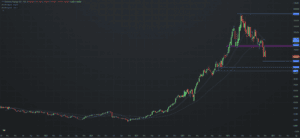
Siemens Power, weekly chart. Supply: etoro
Bitcoin and Ethereum in a market with much less liquidity
Our base case for the subsequent few weeks is that bitcoin continues to consolidate. Nonetheless, we see a better threat of one other leg down than of a sustained restoration.
Spot bitcoin ETFs ended the week with $1.28 billion in web outflows. Stablecoin market capitalization additionally fell 2.2% over seven days, pointing to much less potential liquidity within the crypto market. If each traits persist, a rebound will probably be more durable to maintain.
On November 4, solely 38% of the bitcoin held by short-term holders was in revenue. On Friday, cash from that group that moved on-chain did so, in mixture, at a slight loss. If the worth returns to their entry ranges, some current patrons might use the chance to exit, slowing the rebound. We’d search for the rally to carry, a bigger share of these cash to maneuver again into revenue, and ETF outflows to ease.
For Ethereum, the query is whether or not ETH can regain floor in opposition to BTC. If bitcoin rebounds and ETH lags, the restoration will stay concentrated in bitcoin. If ETH outperforms for a number of periods and different liquid crypto property observe, that may level to a broader restoration. Over the long term, fund tokenization is increasing institutional use of ethereum. Its influence will depend upon how a lot capital is managed by means of the community and the way a lot exercise it generates.
Over the subsequent two to 4 weeks, we estimate a 50% likelihood of consolidation, with flows stabilizing and up to date patrons hovering close to break-even. We assign a 30% likelihood to a deeper decline if ETF redemptions persist and realized losses rise on-chain. The remaining 20% goes to a firmer restoration, with enhancing flows, extra short-term holdings again in revenue, and ETH regaining floor in opposition to BTC.
The following US inflation report may transfer the greenback and bond yields. We’ll watch what occurs within the periods that observe. If the rebound holds and flows enhance, we’ll give the restoration situation extra weight. If costs rise whereas outflows proceed, we’ll stay cautious.